
A standards stack in a single booth — looking back on the 1EdTech Korea joint booth at EdTech Korea Fair 2026
1EdTech Korea ran its first joint booth together with its founding members and PowerSchool, a 1EdTech Global member. The booth showed in one place how standards connect everything from class rosters to credentials, and visitors' questions moved from whether products can integrate to whether they can be trusted.

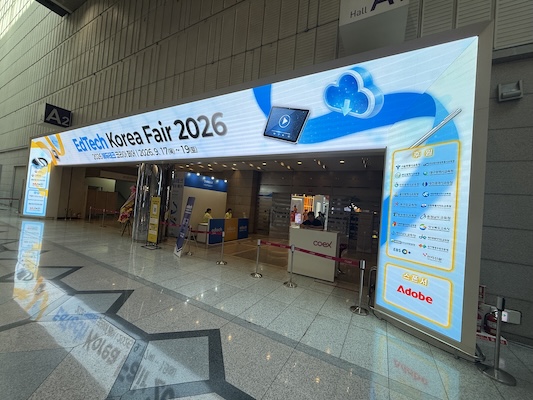
At EdTech Korea Fair 2026, held at COEX in Seoul from September 17 to 19, 2026, 1EdTech Korea ran a joint booth for the first time. Full member recruitment had not yet begun, but four founding member organizations and PowerSchool, a 1EdTech member, came together to staff the booth.

[Photo 1] The 1EdTech Korea joint booth alt: The 1EdTech Korea joint booth in Hall A at COEX during EdTech Korea Fair 2026
1. Why a standards organization did not stand alone
Explaining a standard is rarely enough to convey its value. What visitors want to know is not what the specification says but what the standard lets them connect. So the booth was set up for 1EdTech Korea to introduce the standards while, in the same space, member companies showed products that put those standards to work.
Over the three days, conversations also ran between the participating companies themselves. The first outcome of the booth was a shared willingness to connect one another's products through LTI, OneRoster, CASE and Open Badges, and to create business opportunities together.
2. The flow of standards, seen in one booth
Taken one by one, the five organizations' exhibits are different products. Placed in the order in which school data flows, they become a single stack.
Student rosters and academic records — PowerSchool
PowerSchool is a global platform in the student information system (SIS) space. When a SIS supports OneRoster, the edtech standard for roster data, out of the box, the edtech apps and content built on top of it can receive class and student rosters securely, without custom development. It was the most intuitive demonstration at the fair of how much standards lower the cost of integration.
Assessment and feedback — DataDriven Clipo
This was where K-12 teachers gathered most. Performance assessment in Korean schools calls for a complex system in which achievement standards, rubrics and written feedback are intertwined. Clipo uses optimized AI workflows and multi-agent technology to support reliable scoring and feedback throughout that process. Visiting teachers responded especially well to its responsible use of AI and its ability to explain the basis for each score. It reaffirmed that the benchmark in the classroom is not whether AI can score, but whether the score can be explained.
Standards: curriculum and achievement standards are handled through CASE (Competencies and Academic Standards Exchange).
Learning experience — Artygenspace Book.ar
Book.ar combines AI and AR to reshape reading experiences for young children, and it drew strong interest from school library staff. As a playful pairing of augmented reality content with AI, its visual impact made it one of the most popular stands at the fair, and the event gave the company a chance to explore how its technology can extend further through edtech. Artygenspace is a past CES Innovation Award honoree, and at this year's fair it received the Minister of Trade and Industry Award in the business model category.
Standards: 1EdTech certified for OneRoster and LTI.
Learning data and analytics — WickedStorm Lecognizer
Lecognizer is a one-stop data analytics platform that collects learning data in xAPI and Caliper formats simultaneously and carries it through to learning analytics. Consultations came not only from Korean universities but also from overseas buyers, and there were inquiries about CASE Repository and the Comprehensive Learner Record (CLR), neither of which was on display. We read this as a sign that demand already exists for a path running from data collection to competency alignment and learning records.
Standards: makes broad use of xAPI, Caliper, CASE and CLR.
Proof of achievement — 【레코스 — official English name to be confirmed】
The company introduced its digital badge platform supporting Open Badges 3.0 to K-12 and university stakeholders. It is a live service with built-in security and verification, and the company stated that it holds the largest record of digital badge issuance in Korea. It emphasized that digital badges are undergoing a paradigm shift from issuance to value, and there was extensive discussion of how digital badges can accumulate and be managed within a Comprehensive Learner Record.
Standards: 1EdTech certified for Open Badges 2.0, 2.1 and 3.0.

[Photo 2] Member product demonstrations and visitor consultations alt: A member company demonstrating its product to visitors at the 1EdTech Korea booth
Starting from rosters (OneRoster), moving through assessment and learning experience and on to learning data (xAPI and Caliper), and arriving at competency alignment (CASE) and proof of achievement (Open Badges and CLR). Each company showed its own domain, but visitors could see the whole flow, connected by standards, within a single booth.
3. Integration was easy; the questions turned to trust
The PowerSchool area of the booth drew a particularly large number of Korean edtech companies. Most of their questions concerned how to integrate their products through the PowerSchool partner program, and the business model involved.
Technical integration itself is unlikely to be a major barrier, since PowerSchool's SIS supports OneRoster out of the box. What matters more is what comes next. To enter the US school market, including international schools, a product must pass evaluation and validation of its stability and reliability, its multilingual support and the real demand for it.
This lines up exactly with the message repeated at Learning Impact this year. Standards make connection possible, but it is trust that opens the door to the market. How Korean companies can earn trust signals such as conformance certification and TrustEd Apps is the next challenge 1EdTech Korea must work through together with its members.
4. Looking back on a first joint booth
Given that this was a first attempt at a joint booth, we judge it to have been a satisfying experience for both the participating companies and visitors. Taking part in a trade fair is, however, a costly undertaking. As it reviews this year's participation, the 1EdTech Korea board will also discuss other ways of taking part in fairs.
Whatever form it takes, 1EdTech Korea's activity will continue at edtech fairs held in Korea in 2027. From a place that explains standards to a place that shows products connected by them — this booth was the first step.
Product descriptions are based on information provided by each company, and summarize the conversations about edtech standards held at the 1EdTech Korea booth.