
Facing more than 100 edtech standards: reading them through workstreams
Revisiting a 2022 KERIS issue report in 2026. 1EdTech regrouped its 100-plus standards into six workstreams — an argument for starting from the problem you are trying to solve rather than from the catalog of standards. Four years on, that diagnosis holds more firmly than it did then.

In 2022, the IMS Global Learning Consortium, which had developed international edtech standards for more than two decades, renamed itself 1EdTech. The change announced a shift in the organization's center of gravity: from a body that writes standards to one that makes standards get used. That same year, the Korea Education and Research Information Service (KERIS) published the issue report Understanding EdTech Standards Through Learning Impact 2022 and the Workstreams, which set out the background to that shift and, alongside it, the order in which Korean practitioners should approach a catalog of more than 100 standards. Four years later, the reason to return to this report is that its diagnosis still holds.
Part 1. What the issue report said
From an organization that writes standards to one that gets them used
Beginning with a metadata standard in 1999, IMS Global developed more than 100 standards. The report identifies three things that set the consortium apart: member institutions build and share reference code for implementation; the consortium surfaces and circulates use cases from educational practice; and expert reviewers assess and certify products and services that apply the standards. Development cycles are kept short, at roughly a year, and no standard is approved for release until at least three organizations have implemented it in a working product. These are procedures designed to keep a standard from remaining nothing but a document.
The move to 1EdTech pushed that direction one step further. The consortium redefined itself as an inspiring organization and an inspiring brand, and moved its priority from developing standards to adoption and impact.
Three scenes from Learning Impact 2022
Held in Nashville, Tennessee, this was the first in-person edition of the conference since the pandemic. Its discussions fall into three strands.
A new normal for post-pandemic education. Drawing a line between equality and equity, the argument that equity is the more urgent priority for US education came to the fore. One empirical study on personalized learning, which inserted AI-generated questions into digital course materials, was presented along with its finding that there was no significant difference between questions written by AI and questions written by people.
Advances in assessment technology. QTI 3.0 was released after seven years of development and validation. Broader HTML5 support is intended to make digital assessment easier to implement in web environments, and the discussion extended to redesigning assessment around formative practice.
Learner profiling. Digital credentialing began to reach beyond higher education into secondary curricula. The Georgia Department of Education launched policy in this area after some three years of deliberation, and Norway's Ministry of Education adapted OneRoster to national conditions in order to automate administrative work such as student profiling and account provisioning.
Workstreams as an answer to 100 standards
A single standard consists of several resources — an information model document, an implementation guide, reference code, schema files, a certification guide and so on — and successive revisions leave multiple versions in circulation. Deciding which of the 100-plus standards fits your situation, and which version to use, therefore becomes a difficult judgment for anyone who has not taken part in the standards work itself. What to look for, how, and where to begin: the report diagnoses this as a high barrier to entry.
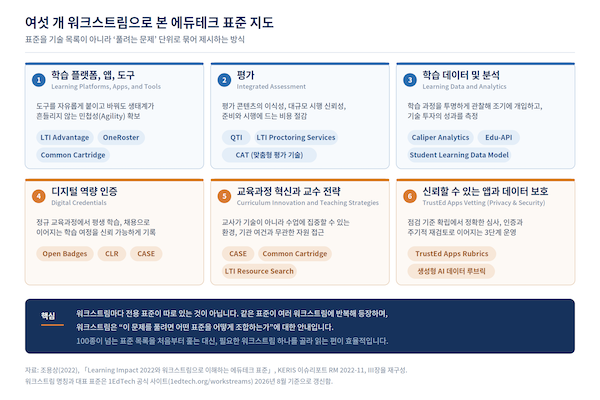
1EdTech answered with a full redesign of its website, placing the essential standards and implementation guides for each workstream in the top-level navigation. The important point is that no standard belongs exclusively to one workstream. A workstream is guidance on which edtech capabilities can be combined for a given purpose, which means you can pick the single workstream you need and read only that.
- Learning platforms, apps and tools — the agility to add or replace tools without disturbing the environment already in operation
- Assessment — portability of items and item banks across vendors, reliability at scale, lower preparation and delivery costs
- Learning data and analytics — early intervention capability in K-12, return on technology investment in postsecondary education, lower data integration costs in industry
- Digital credentials — a record of the three-stage learning journey running from formal education through lifelong learning to employment
- Curriculum innovation and teaching strategy — an environment in which teachers attend to instruction rather than technology, and access to resources regardless of institutional circumstances
- Trusted apps and data privacy — a three-stage operation of establishing vetting criteria, conducting accurate review, and certifying with periodic re-review
[Figure 1] A map of edtech standards seen through the six workstreams
What the report concluded
Its overall assessment was that a consortium which had pursued standardization alone had remade itself as the focal point of a digital learning ecosystem. It made three recommendations for Korea: build a community-based collaboration structure for sharing both successes and failures in edtech adoption; extend the idea of equity beyond learning gaps to the disparities that institutions and companies face because of region or socioeconomic background; and establish an open structure that accommodates collaboration between company and company, school and company, and school and school.
The report's closing paragraph assesses conditions in Korea as follows. There was as yet no case of government and the private sector, or the public sector and industry, working together; no private body had taken part as a stakeholder on equal terms with government or public institutions; and the groundwork for measuring and demonstrating outcomes was missing.
Part 2. Reading it four years on
The structure survived
As of August 2026, the official 1EdTech site still describes the organization in terms of four leadership areas and six workstreams. Only some of the labels have been adjusted. TrustEd Apps and Data Privacy became TrustEd Apps Vetting, Higher Education became Postsecondary Education, and the description of digital credentials gained language about recording and verifying achievement.
Four years is not a short span in edtech. Generative AI changed the premises of educational practice during that period, and the frame held anyway — which reads as evidence that the six divisions were not lines drawn to follow a trend, but lines drawn along the boundaries of the problems institutions actually run into.
What changed and what did not
What changed is the generation of the standards. OneRoster 1.2, which the 2022 report listed as forthcoming, has settled into place; Open Badges and CLR have moved to 3.x and 2.x respectively. Edu-API sits at the front of the standards menu, and the TrustEd Apps rubric has added items covering generative AI data. What did not change is the barrier to entry. If anything, as the standards multiply and version numbers climb, the question of what to adopt and where to begin only becomes harder to answer.
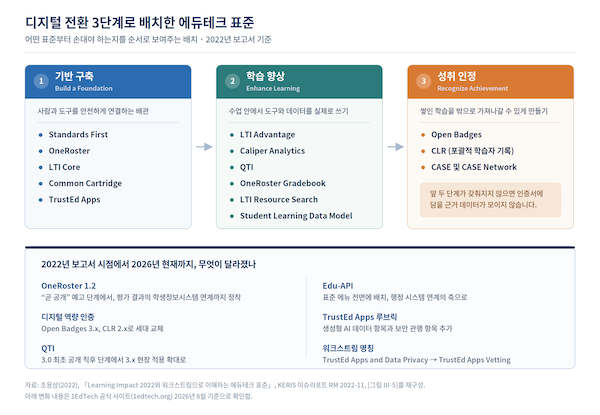
[Figure 2] Edtech standards arranged across the three stages of digital transformation, with changes through 2026
The problem acquired a name
At Member Assembly 2025, 1EdTech addressed this problem directly. As adoption of the standards rises, the average level of standards literacy among implementation teams falls. More teams are encountering the standards for the first time, so variance in interpretation and application widens, unofficial extensions proliferate, and implementers increasingly lean on large language models to interpret specifications. Ambiguous specifications produce misunderstanding, misunderstanding produces divergent implementations, and divergent implementations produce interoperability failures.
What the 2022 report described as a high barrier for anyone meeting the standards for the first time has, four years later, become the top-priority agenda item under the name of adoption. Workstreams were the first response to that problem, and they remain the easiest place to start.
Where to pick it up
- Start from the problem, not the catalog — the first question is not which standard to adopt but what problem you are trying to solve. A workstream is the device that carries that question over to the standards.
- Keep the sequence — skip the foundation work and issue badges first, and no evidentiary data remains to put inside the badge. The three stages in Figure 2 are not recommendations but dependencies.
- Treat consistency of interpretation as shared infrastructure — if every implementation team reads the standard differently and extends it on its own, connections break inside Korea's own ecosystem well before global interoperability is at stake.
In closing
The 2022 report ends on the observation that Korea had no instance of government and the private sector, or the public sector and industry, collaborating. Four years after that sentence was written, the case for a place where standards can be read together and interpretations shared has only grown clearer.
August 20, 2026 — marking the launch of the 1EdTech Korea website.
References
- Cho, Yong-Sang (2022), Understanding EdTech Standards Through Learning Impact 2022 and the Workstreams, Korea Education and Research Information Service, Research Material RM 2022-11 (in Korean)
- 1EdTech, Workstreams, 1edtech.org/workstreams, accessed August 2026
- Tim Couper, "The Road to Easier Adoption," 1EdTech Member Assembly 2025