
AI became a tool for cheating. Why did we let the AI proctor go?
The AI-assisted cheating on Korea's tax accountant exam came to light only after the exam was over. This piece looks at how AI can find the moments proctors missed, even in paper-based exams, and how international standards turn those moments into fair decisions.

In November 2026, a warning light went on for Korea's examination system.
This year's top scorer on the national certified tax accountant exam confessed to cheating with generative AI. By that person's own account, they photographed the exam questions with a miniature camera, sent them to an AI service, and checked the answers on a smartphone. The same method was used in both the first and second rounds of the exam, and again in the first round of the certified public accountant exam.
Sneaking a phone into an exam room is nothing new. This case is different. No accomplice outside the room is needed to feed the answers. AI does that job.
What hurts more is something else. The cheating was not caught in the exam room. Scores that were almost too high to believe raised suspicion, and the truth came out only through the person's own confession. By then the list of successful candidates had already been announced.
The Office of the President called an emergency meeting, ordering a full review of suspected cases and a focused check of the proctoring system for the College Scholastic Ability Test (CSAT, Korea's national university entrance exam) on November 19. Staff dedicated to smart glasses are being placed at every test site, and the rules on banned items and penalties have been reissued.
All of these steps are necessary. But a different question came to my mind.
Is there a way to find, after the exam is over, the moments that proctors missed in the room?
No one can catch everything on site
AI glasses are hard to tell apart from ordinary glasses by appearance alone. At last month's parliamentary audit, it emerged that metal detectors and radio-frequency detectors failed to catch AI glasses during a mock drill for national qualification exams. And no single proctor can watch dozens of candidates without a gap for hours on end.
The CSAT rules already admit this limit. Even if a candidate is not caught in the room, the same penalty applies if a report comes in after the exam. The problem is what comes next. When a report arrives, what do we use to establish the facts? Without a record, suspicion stays suspicion, and a wrongly accused candidate has no way to prove their innocence.
So the question has to change. Not "can we catch everything on site?" but "can we go back and check the moments we missed?"
The world has been preparing proctoring standards for years
The COVID-19 pandemic in 2020 moved the exam room online. Is the student taking the test at home really who they claim to be? Are they getting help from someone else? Who checks? Remote proctoring technology spread quickly to answer those questions.
Even earlier, in July 2019, 1EdTech, the international standards body for education technology, released LTI Proctoring Services, which connects assessment platforms and proctoring tools in a standard way. Products from different companies can connect the same way to verify a candidate's identity, start proctoring, and pause the exam when needed.
One part of the specification deserves attention. When a proctoring tool spots something suspicious, it leaves a flag saying "human review needed," with when it happened, how serious it is, and why. And that flag can be sent even after the exam has ended. The design anticipated after-the-fact review from the start.
An AI proctor born in Korea
A Korean company took on this challenge too.
EDINT, which started in Samsung Electronics' in-house venture program C-Lab, built an AI proctoring service called Proctormatic. Instead of a person watching every candidate in real time, AI analyzes the candidate's gaze, posture, and surrounding objects, records unusual behavior, and a person reviews the results after the exam.
The technology first drew attention on the international stage. It won a CES Innovation Award, was integrated into a shared-university program involving 15 Korean universities, and was recognized at the 2025 Intellectual Property Startup Competition.
But applause at trade shows did not easily turn into adoption in exam rooms. Institutions asked other questions before they asked about performance. Who is responsible if the AI mistakes normal behavior for cheating? How are videos of faces and gaze managed? Should we pay for this even in a year with no cheating?
It is the paradox that security technology always faces. Before an incident, it looks like a cost. Only after an incident does it look like an essential investment.
And there is sad news to share. EDINT has recently reached a point where it can no longer continue its business. The website of a service that once stood on the CES stage is now closed and hard to find even by search.
At the very moment the news that AI had become a tool for cheating shook the whole country, the Korean technology built to catch that cheating was quietly closing its doors.
From one candidate to a whole classroom
Still, the possibilities this technology left behind have not disappeared. EDINT's video analysis technology was also used in an experiment in corporate classroom training, analyzing the posture and movement of many participants together from a camera in the training room.
What this experiment shows is significant. It means the behavior of many people can be observed at once with a single camera covering the whole room, not a smartphone camera pointed at one candidate. That is exactly the technology a paper-based exam room like the CSAT needs.
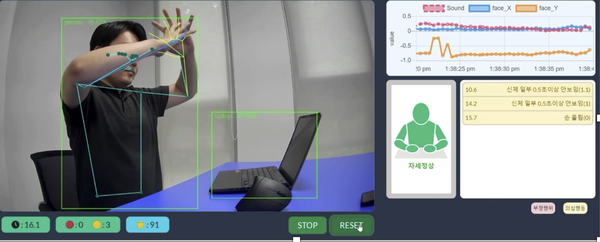
Here is how it would work. The exam room is recorded, and after the exam, AI picks out suspicious segments: a hand that keeps touching the arm of a pair of glasses, repeated movement under the desk, a gaze that keeps turning in the same direction. Korea's Ministry of Education has itself advised proctors to watch for candidates who often touch the arms of their glasses during an exam. Proctors would not need to watch hours of footage from the beginning. They would only need to recheck the few minutes the AI flagged.
A screen where AI recognizes posture, hand movement, and surrounding objects in video, and records suspicious behavior with the time it occurred. Proctors can follow this log to review only those scenes.
Think back to the tax accountant exam. If the exam footage of that candidate could have been reviewed when suspicion arose over abnormally high scores, the truth would have come out without waiting for a confession. And for a candidate who earned a high score honestly, that footage would have proved their innocence.
Of course, gaze or posture alone cannot establish cheating. What AI finds is not evidence but scenes worth a second look. The judgment must be made by people who weigh the exam rules, the situation in the room, and other evidence together.
In paper-based exams, the best thing AI can do is not to replace the proctor. It is to lend the proctor a second pair of eyes after the exam is over.
Standards turn scenes into evidence
For the scenes AI finds to lead to fair decisions, some questions must be answered first.
Which behavior counts as a suspicious circumstance? Who keeps the footage, and for how long? Who makes the final decision? How does a candidate explain themselves and appeal?
What happens if the answers differ from exam to exam and institution to institution? The same behavior becomes cheating in one exam and no problem at all in another. At that point, technology stops protecting trust and becomes a new source of distrust. That is why international standards are needed.
ISO/IEC 23988 is the international standard for running IT-based assessments fairly and reliably. The first edition was published in 2007. The second edition, for which I serve as editor, has completed all development, ballots, and reviews and is now heading to publication. It covers AI-assisted proctoring, detecting and recording irregularities during an exam, review by human proctors, post-exam investigation, and candidate privacy and appeal procedures.
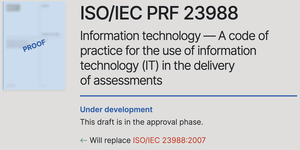
The second edition of ISO/IEC 23988 (PRF), now in the approval phase. Once published, it will replace the 2007 edition.
The principle underneath it fits in one sentence.
AI detects; humans decide.
1EdTech standards provide a way to exchange those records in the same format among exam bodies, proctoring tools, and investigating agencies. Even if the proctoring tool changes, or a different institution reviews the record, the same scene remains the same record.
When the two standards work together, on-site proctoring, video recording, AI analysis after the exam, human review, and the candidate's explanation connect into one trustworthy process. Standards do not force anyone to use a particular product. Whatever technology is used, they provide common rules for handling its results fairly.
1EdTech Korea will listen to the field
Today's LTI Proctoring Services was designed with online exams in mind. It does not yet fully address the needs Korean society now faces, such as after-the-fact analysis of footage from paper-based exam rooms.
Based on the needs this incident has revealed in Korea, 1EdTech Korea plans to hear from stakeholders, including exam bodies, education authorities, universities, and edtech companies, on whether to propose a revision of LTI Proctoring Services to 1EdTech. A problem that surfaced in Korea could become the next task for an international standard.
Will we look for technology only after cheating breaks out?
After a major financial incident or data breach, security investment finally grows and regulations tighten. Exam proctoring may be walking the same path.
Of course, AI alone cannot stop every form of cheating. Device controls, proctor training, technical detection, and post-exam evidence analysis must work together. But the limits of technology are no reason to turn away from it. With this incident in mind, I would like to offer a few proposals.
- Pilot after-the-fact review, starting with paper-based exams. There is no need to bring it into every exam room at once. Run video recording and AI review on a trial basis at some test sites, and make the results and limitations public.
- Set the rules before the technology. Data minimization, video retention periods, access rights, and procedures for explanation and appeal should be designed together with the technology. The second edition of ISO/IEC 23988 is a good starting point.
- Connect through international standards. Assessment platforms and proctoring tools must not be locked into a single vendor if adoption and maintenance costs are to come down.
- Give Korean companies a chance to prove themselves in real exams. What innovative companies need is not another award plaque, but a chance to have their effectiveness and limits fairly tested in real exam settings and to improve their products.
Closing
AI can become a tool for cheating, or a tool for protecting trust in exams. Which one it becomes depends not on the technology but on the principles and systems within which we use it.
Korea had a company that took on AI proctoring, and the world has been preparing standards to use that technology fairly. Even so, it is time to ask whether, each time an incident breaks out, we have stopped at adding more proctors and longer lists of banned items.
Sadder than an innovative technology failing to prove itself in the market is remembering that it existed only at the moment we truly need it.
Fairness in exams in the age of AI cannot be protected just by adding more eyes in the room. We need both the technology to look again at the moments proctors missed, and the standards that turn those moments into fair decisions.
This article reflects the author's views based on international standardization trends and a Korean technology case. It does not recommend any particular product, nor does it suggest that AI detection alone proves cheating.