
Steward the data, not another platform — the 1EdTech community's response to the US Department of Labor on workforce information, and what it means for Korea
Six organizations including 1EdTech submitted a joint response to the US Department of Labor. Its message comes down to one line: government should steward the data, not build platforms. It raises questions that carry straight over to Korea's discussions of digital badges and learning records.

In August 2026, the US Department of Labor's Employment and Training Administration (ETA) issued a Request for Information (RFI, 91 FR 34833) on modernizing CareerOneStop, its career information tool, and O*NET, its occupational information network. Six organizations — 1EdTech Consortium, AEM Corporation, C-BEN, Credential Engine, HR Open Standards and The EdTech Collaboratory — submitted a joint response, and ten organizations including the Bipartisan Policy Center signed on in support.
The document is addressed to the US federal government. Yet the question at its heart — how a nation should handle data on occupations, competencies and credentials — applies just as directly to Korea. With discussions of digital badges and a learning record management framework under way in Korea, it is worth reading now.
Part 1. What the response said
The core argument: data, not platforms
The response starts from a question the RFI itself posed: what should CareerOneStop not build, because it already exists elsewhere?
The answer is concise. The federal government's highest-value role is not platform builder but data steward and infrastructure provider. Workers already reach career information through state talent platforms, employer platforms, community college advising systems and, increasingly, AI-powered search and conversational tools. A federal portal that tries to compete with them takes on duplication and obsolescence at the same time.
Specifically, the response names a parallel credential registry, a course equivalency database and a new learning and employment record (LER) standard as things not to build, because Credential Engine's Credential Registry and 1EdTech's CLR 2.0 and Open Badges 3.0 are already in operation. The heart of the request is to use what exists rather than establish new schemas or taxonomies.
Where it does call for investment: maintaining O*NET as authoritative open data; publishing in formats that are interoperable both digitally and semantically; maintaining crosswalks and identifier registries that let other systems connect their own data without going through the Department of Labor; supporting standards adoption by state and local agencies; and connecting to the credential and transcript infrastructure already running in higher education.
Four recommendations
- Steward authoritative workforce data rather than build another end-user platform — invest first in authoritative, openly licensed data and crosswalks
- Adopt existing open standards with a practical path to implementation — with a two-year conformance deadline set as a condition of federal funding
- Require both digital and semantic interoperability — not only APIs but shared vocabularies, identifiers and published mappings
- Build worker data sovereignty and AI transparency into the foundation — portable, verifiable records, and AI-inferred data labeled with its provenance
Three passages worth noting
First, the distinction between digital and semantic interoperability. The response treats the two separately. Digital interoperability is the technical layer that lets data be exchanged through APIs, documented protocols and common file formats. Semantic interoperability is the layer of meaning that makes the terms and identifiers used by different systems point to the same thing. When an employer asks for "project management," a training provider certifies a "project coordination" competency, and O*NET describes the task as coordinating resources to meet project milestones, it must be possible to determine whether the three are the same thing. In the response's own words:
"Digital interoperability makes data movable. Semantic interoperability makes it useful."
It states plainly that putting fast APIs on top of data whose meanings do not line up does not create interoperability; it accelerates confusion at scale.
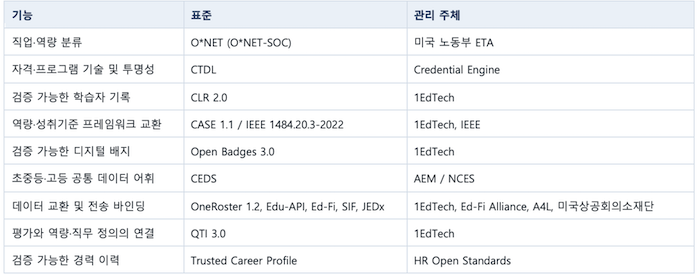
Second, standards are to be aligned, not unified. Setting out several standards in a table, the response explains that they are not competing options for the Department of Labor to choose among but complementary layers of a single interoperable ecosystem. If each standard has one documented path to a JSON-LD and RDF representation, a linked data ecosystem can be achieved without redesigning every standard around a single technical approach.
The table below reorganizes the response's table around the items most relevant to discussions in Korea. The original table is illustrative, not exhaustive.
Third, a job posting is not a job description. The response is clear about the limits of using AI to infer job competencies from job postings. Postings are closer to advertisements meant to attract applicants and do not capture the full scope of the work. Job posting data should therefore be treated as one of several inputs, triangulated with incumbent surveys, review by occupational experts and validated credential outcome data, and items inferred by AI should be labeled as provisional, together with their source, date and verification status. Its position is that such information cannot be given trust without a human-in-the-loop verification process.
Part 2. What it means for Korea
We face the same question
In Korea, too, information on occupations, competencies and credentials is split across ministries and agencies. The National Competency Standards (NCS) are run by the Ministry of Employment and Labor and HRD Korea; Worknet and the Korea Network for Occupations and Workers (KNOW) by the Korea Employment Information Service; vocational training information by HRD-Net; and CareerNet by the Ministry of Education and the Korea Research Institute for Vocational Education and Training (KRIVET). Each has its own portal. The question of whether to build one more portal or to steward the data well applies in Korea exactly as it does in the United States.
Digital interoperability is largely in place. The next question is different
NCS information is already published through open APIs on Korea's Public Data Portal, and classification and competency unit information can be retrieved as JSON or XML. From the standpoint of digital interoperability, a substantial foundation is already in place.
The next question is of a different kind. Whether NCS competency units are published in a competency framework exchange standard such as CASE, and whether they are connected through machine-readable crosswalks to school curriculum achievement standards, qualifications or hiring requirements, is a separate matter. As the response puts it, making data movable and making it useful are different tasks. That distinction describes the situation in Korea precisely.
On granularity, Korea may actually have the edge
The weakness the response identifies in the United States is how abstract O*NET's information is. Each of roughly 1,000 Standard Occupational Classification (SOC) occupations aggregates a great many real jobs, which makes the unit too coarse for course-level curriculum alignment or credential crosswalks. The response recommends adding granularity above and below the occupation level, and publishing competencies and tasks as independent entities reused across multiple occupations.
NCS already has a structure that descends from major categories all the way down to competency units and competency unit elements. Korea's task is not to create granularity but to ask whether that granularity is exposed to outside systems through stable identifiers and published crosswalks. Handled well, this could become a comparative advantage.
It meets the digital badge discussion head-on
Through the Digital Badge Steering Council, the Ministry of Education and the Korea Education and Research Information Service (KERIS) are discussing interoperability grounded in international standards, a quality management system, trustworthiness, and a national learning record management framework, and some see this as the starting point for a Korean learning and employment record (LER) system.
The list of standards and the principles set out in this response can serve directly as reference material for that discussion. In particular, the recommendation to align existing standards rather than create new ones, and the advice not to build a new credential registry or LER standard, are the first sentences worth examining when designing a Korean system.
Using funding as leverage
The response proposes a two-year conformance deadline, made a condition of federal funding. At the same time it adds a caveat: the systems that actually produce and consume the data are existing ones tied to multi-year procurement cycles, so low-burden pathways — crosswalks, reference implementations and adapters that let systems exchange standards-conformant data without being rebuilt — must be provided alongside. A warning also recurs that setting conformance criteria too high will shut out smaller institutions without dedicated technical staff first.
Korea has the same levers: publicly funded vocational training, the Academic Credit Bank System, vocational high schools and government funding programs for universities. What is harder than attaching conditions, however, is providing a pathway to compliance that institutions can actually manage.
In closing
What is most worth carrying over from this response is not the list of individual standards but its sense of the division of roles. Government takes responsibility for authoritative data, and for the identifiers and crosswalks that let others attach their own data to it. The actual tools are left to be built where people already use them. When a similar conversation begins in Korea, this document will be a good starting point.
Read the original
- 1EdTech Community issues response to U.S. Department of Labor RFI — 1EdTech Learning Impact Blog, posted August 17, 2026 → https://www.1edtech.org/blog/1edtech-community-issues-response-to-us-department-of-labor-rfi
Further reading
- Response to Request for Information: Modernizing Federal Workforce Information Tools — Online Career Tools and the O*NET Program (full joint response, PDF, August 2026) → https://drive.google.com/file/d/1Cw_VhbyGlbrAWW1imgyOo8UrvNLLg4_1/view
This article summarizes 1EdTech's original post and the joint response and adds implications for Korea. Apart from the quoted sentence, the body is a summary, not a full translation. Please refer to the originals for exact content.