
Learning Impact 2026 — from plumbing to infrastructure
Reduced to a single sentence, the three days of Learning Impact 2026 come to this: standards are no longer plumbing that lets systems exchange data, but infrastructure on which policy and AI stand.

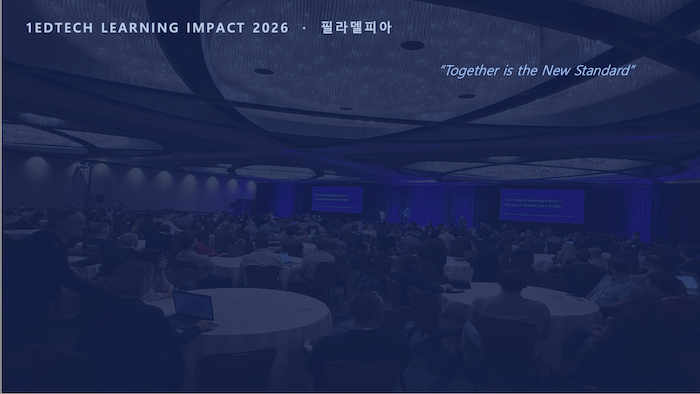
Learning Impact 2026, 1EdTech's annual conference, was held in San Francisco. Reduced to a single sentence, three days of conversation come to this: standards are no longer plumbing that lets systems exchange data; they have become infrastructure on which policy and AI stand.
The event's theme was "Together is the New Standard." This article is drawn from 1EdTech Korea's on-site debriefing.
1. Opening — a different 1EdTech this year
The opening keynote comes down to two scenes.
Responding to the threat environment. A month before the conference, a major learning management system provider suffered a large-scale security incident. 1EdTech's response rested on three principles: approach it through controls, do not blame the vendor, and treat it as a shared responsibility. The argument was that the moment you blame the vendor, you suppress the joint work that actually reduces risk. The keynote offered a striking image: a standards reviewer is not a bouncer at the door of a bar but the engineer who makes the room itself safe.
Making the AI question concrete. The keynote introduced the concept of a Trusted Learning Context: give AI enough information to help and no more, with consent, sovereignty and provenance built into the data itself. The theme returned throughout the three days and is treated separately in Section 5 of this article.
Master theme: yesterday's dots are today's infrastructure
The first stage of standards was solving integration problems; the second was creating markets. LTI, OneRoster, CASE and Open Badges all followed that path. The gist of the keynote was that as standards move into a third stage, the character of the organization itself is shifting in four directions.
- Integration → Orchestration — standards must talk to other standards. The market experiences not the standards but the seams between them.
- Publisher → Enabler — from an organization that develops standards to one that directly enables adoption and implementation.
- Specification → Ecosystem — building not a single standard but an ecosystem whose parts mesh and work together.
- Consortium → Coalition — evolving beyond a membership consortium into a coalition for the public good.
One line from the keynote compresses the premise of the whole event: if educational context is not in governed infrastructure, AI cannot see it — it can only approximate from other data.
2. Organizational change — Project Evergreen and Korea's place
A reorganization for the next 25 years was unveiled. At its core, roles are differentiated under a single mission.
- 1EdTech Consortium, Inc. — the existing standards body. A member-driven 501(c)(6) organization that defines and certifies open interoperability standards, governed by an elected Membership Executive Board.
- 1EdTech Global, Inc. — a new coordinating hub. A public-benefit hub with 501(c)(3) status pending, and the center of shared services for philanthropy, education, research and international coordination.
- 1EdTech Global Network — an international community of local entities and their governance. It includes Korea (established 2026), Europe (AISBL, 2026), Canada (2026), LATAM (2025) and Japan.
The phrase that summed up the background to the reorganization was "Standards became policy infrastructure." Once standards have become policy infrastructure, there need to be entities that actually operate that infrastructure in each region.
Korea's position
1EdTech Korea was introduced as currently active, and Korea was included as one of seven early adopter reference nodes in the newly launched CASE Global Ecosystem.
On the global policy panel "How Are Standards Shaping Global Policy Conversations?", the Chair of 1EdTech Korea joined representatives of the Europe Consortium, LATAM and Japan and presented "AI in Learning: The View from Korea." The session's subtitle was Trusted, Inclusive, Scalable — AI Powered by Open Standards, and those three words also give the rest of this article its structure.
The panel set out Korea's AI landscape in five points.
- System-wide demand and mature pedagogy — personalized learning in K-12; AI competencies and career pathways in higher education
- Process-based assessment — AI rubrics, open-ended scoring and real-time feedback, beginning and ending with the teacher
- A homegrown category — intelligent item bank services that combine an AI exam proctor with a dynamic item bank
- The ecosystem paradox — agile startups and data-holding legacy providers split apart, producing costly duplicate integrations
- A governance mandate — school operating committees vet security and privacy before any edtech procurement. [+] School operating committees are statutory bodies of teachers, parents and community members that deliberate on each school's major decisions.
The third is a market category rarely seen in other countries; the fourth is the item that most precisely explains why Korea needs standards.
3. Trusted — trust is infrastructure
Why trust became infrastructure
A learning ecosystem is a complex system in which people, content, technology, data and governance are intertwined. The session started from the premise that the era of people configuring trust by hand, one relationship at a time, is over.
The duplicated vetting burden in US K-12 was offered as evidence. A district uses 2,500 apps a month; a privacy review of a single app takes 15 hours; and 12,500 districts nationwide each review the same apps independently. Altogether that is more than 500 million hours a year.
On top of that, AI agents are multiplying rapidly: access to tools and data is surging while the way trust is configured has not changed. Manual configuration cannot keep pace with today's scale and speed, so the conclusion was that trust itself must be built as structured infrastructure.
In short: trust = structured signals from certification, rubrics and compliance (SOC 2, HECVAT, VPAT). It scales only when machines can read and verify it.
The hierarchy of trust
Three parties experience the same infrastructure differently.
- Trust · faculty and staff — they browse the catalog of approved apps, put them straight into their courses, and request tools not yet listed. This is where trust actually operates.
- Transparency · IT and academic support — the layer that builds and manages the catalog. Listing a tool is itself a signal that the institution supports it.
- Interoperability · edtech providers — they see how they compare with competing products in the directory and learn what this market values.
Four shared rubrics run through all three layers: data privacy, security, generative AI and accessibility.
TAMS — the platform that operates trust
The S in TAMS stands for Suite. Four components form a single trust cycle.
- Dashboard — institutions curate and manage the apps they have approved, with evaluations, metadata and comments in one place
- Directory — the place of discovery; the handoff point between providers and institutions, bringing together vetting, certification and trust information for 14,000 apps
- Diagnostics — real-time testing, with immediate feedback on standards conformance over an API connection
- Certification — standards certification is where the trust signal begins, with rubrics and compliance layered on top
The cycle runs from product testing through 1EdTech certification, directory listing and institutional curation to use in the classroom, with an engaged community at its center.
Reported benefits from the field included managing the edtech portfolio, auditing and identifying third-party apps, simplifying the ecosystem, reducing procurement complexity and duplicated work, eliminating vendor lock-in, and guaranteeing institutions access to their own data for improvement. An LMS service lead at one university said that adopting TAMS meant they no longer needed to maintain an internally built management tool.
2026 platform roadmap
The edtech security roadmap, launched in response to the security incident, is oriented toward a two-sided market. Security offices are often seen as the office of no; the plan is instead to integrate standards deep into systems, break down silos, and structure trust signals in a market that links institutions and providers. Institutions reduce procurement friction; providers close contracts on the strength of trust information. They are two functions of the same platform.
- Q1 (complete) — TAMS Auth0 integration, CASE Network transition, Edu-API final, AI rubric final
- Q2 — standards portal, CASE Global pilot, AI trust context, TAMS upload
- Q3–Q4 — LTI Asset Processor, TAMS certification requests, accessibility rebuild, badge services
The new product directory, PD3, spans K-12, higher education and workforce across every continent, and accommodates tiered organizations such as districts, systems, consortia and governments, along with a governance policy engine. The Build portal aims to shorten certification time for Edu-API, LTI, Open Badges, CLR and OneRoster through real-time testing and AI debugging.
4. Scalable — AI and assessment
The premise of this track was clear: AI is not a grader that replaces teachers but an auxiliary engine that completes the learning cycle.
Why formative assessment is learning itself
Evidence from cognitive science came first. The brain learns on four pillars — attention, active engagement, feedback and consolidation — and a good formative assessment tool makes all four happen repeatedly in the classroom. The learning cycle runs from concrete experience through reflection and abstract hypothesis to active testing, and learning occurs only when a full turn is completed.
Formative assessment is therefore less an assessment than a cognitive device that generates learning. What matters is not how often students are tested but the repetition of retrieval and feedback.
Adoption depends not on features but on frictionless infrastructure
Clicker tools, reduced to taking attendance, ended up distorting formative assessment, and after the pandemic, tool fragmentation increased costs for students along with security and support burdens. The requirements in a request for proposals one university issued in 2025 are telling: easy access through LTI, faculty flexibility, ease of use, scalability, accessibility, mobile and AI, roadmap, and support. What it asked for was not a tool with many features but one that works naturally inside the LMS.
The results after ten months: 1,237 active presenters, 433,500 responses and 93,358 sessions of participation (about 3,200 unique users). It spread through newsletters and self-service alone, without a large training program, and support tickets were mostly short questions and troubleshooting. The case showed in numbers that adoption depends not on good features but on frictionless infrastructure.
Generating is easy; good items are hard
"Generating items with AI is easy. Generating good items is hard."
The bottleneck is not generation but validation. The risks identified in AI-generated items included hallucination, incorrect answer keys, ambiguity, weak distractors, difficulty drift, misalignment with learning objectives, bias and inclusivity problems, and accessibility problems; human-in-the-loop was framed not as optional but as essential.
The proposed solution was an Item Validator. It attaches quality signals to each item and flags weak, biased or defective items before they reach learners, while final authority rests with subject matter experts (SMEs). It uses an LLM as judge under human supervision and reports transparently, trait by trait. It starts with an initial set of 14 traits for text items and 6 for multimodal items and is built to expand, and the validator is designed as an independent component. The key is that this is multi-trait validation, not a binary of good and bad items.
The validator is itself validated. Each item is run three times, mixing model families, versions and sizes, under two aggregation rules: majority vote and consensus. Performance rises when three LLMs from different vendors all agree; precision improves, while recall varies by trait. The principle is not to trust a single model or a single run.
Two Korean cases on stage
Scoring grounded in CASE alignment. This case shifted the question from whether AI can score to whether the score can be explained and trusted. Curriculum and achievement standards are structured with CASE and serve as the reference information for AI scoring and feedback generation; they are also used to set the scope of the subject-specific capability notes and behavioral characteristics entries written under process-based assessment. [+] In Korea's school life record, the official cumulative record kept for every student, teachers write narrative notes on subject-specific capabilities and on behavioral characteristics alongside grades. Of the six stages, the common core (CASE import → submission → scoring and feedback) can be reused anywhere in the world, while the policy extension (subject capability notes → behavioral characteristics → comprehensive record) is specific to the context of Korea's school life record. The principle is standards-first, rubric-first, AI second.
Evidence was presented as well. Agreement between AI and teachers reached an ICC of 0.78, above inter-rater reliability among human graders (about 0.70); by subject, social studies was 0.85, English 0.80 and mathematics 0.72. In a survey of teacher perceptions (N=1,405), scores were 4.34 for efficiency, 4.21 for fairness and 4.07 for autonomy, and scoring time fell by 42%. Usage spans 5,056 schools, 28,840 teachers and 2.7 million AI-assisted assessments, with a 91.2% recommendation rate and a 49.7% reduction in psychological burden.
From proctoring to coaching. This case repositioned monitoring technology from always-on surveillance to an opt-in capability switched on by policy. A QTI 3.0 and APIP-based item bank forms the core, CASE-based automatic item generation forms the intelligence layer, and secure delivery and proctoring form an optional layer. The principle is AI detects, humans decide: AI detects anomalous behavior, while people handle judgment, appeals and sanctions, and integrity flags are kept separate from scores and ability estimates. What stands out is that integrity technology is no longer a separate product but has moved inside a standards-based item bank that carries meaning.
Relatedly, the second edition of ISO/IEC 23988 establishes integrity as a principle across the entire assessment lifecycle and adopts QTI as a normative reference. The Chair of 1EdTech Korea serves as editor of this standard.
Feedback on both cases pointed the same way: the future of AI assessment is not simple automated scoring or remote proctoring, but standards-based assessment infrastructure that aligns meaning through CASE, strengthens items and accessibility through QTI and APIP, and preserves final human judgment.
5. Trusted (2) — data AI can trust
This was the newest conversation of the year: Trusted Portable Learning Context (TPLC), a trust structure for learning context. In one line: MCP is the technology that opens the door, and TPLC is the trust contract that decides what goes out, to whom and under what conditions.
AI failure is context failure, not model failure
Without context, AI drifts into one of three outcomes.
- Refusal — it stops acting, saying it cannot help with that
- Generalization — it offers a plausible answer that is wrong for this learner, this course and this context
- Hallucination — it produces a confident answer not grounded in institutional data
The premise of the discussion was that the answer is not a bigger model but governed learning context. At the same time, AI is moving from conversation to action. When several agents divide up a task and pass context to one another, every step must see the same learner, the same course and the same policy boundaries consistently. Existing integration patterns built on single-resource REST calls, institution-level authentication and overnight batch jobs cannot deliver immediate, learner-level context to agents.
Learning context = exactly as much as needed
TPLC is defined as follows: a time-bounded description of a situation, assembled from authoritative sources and controlled by institutional policy, that tells AI who, what, why, when and what is relevant. In the words used, "enough to act, and no more."
The key is to carry not a whole system but only the thin slice needed at this moment — assembling thin slices from several sources rather than the deep record of one system.
Not the ingredients but the recipe changes
TPLC is not a new standard. It is a recipe for assembling ingredients agreed over 25 years — OneRoster, Caliper, CASE, Open Badges, CLR, Identity — to fit a particular learning moment. AI does not change the ingredients; what changes is how they are assembled. No new schema is created; existing vocabularies are referenced and combined.
Why, then, is agent memory — a folder of Markdown files or a local database — not enough? Three reasons were given.
- Expiry — the data itself encodes course completion, consent periods and credential validity
- Provenance — it distinguishes an institution's source facts from the inferences or hallucinations of an upstream agent
- Policy@release — consent is applied by the institution before release, not dependent on the cooperation of the consuming agent
Six candidate properties — three operational, three trust
The operational layer is implementation-agnostic and needed with any transport.
- Realtime — compiled at the moment of action
- Querying — agents pose broad semantic questions
- Composition — a single artifact spanning multiple systems of record
The trust layer is a governance requirement rather than a technical one: a question of who permits, who enforces and who verifies.
- Consent — not a banner click but a deterministic filter applied before release, evaluated against purpose, requesting agent, learner preferences and institutional policy
- Sovereignty — policy is enforced at the source, not by the consumer, and is not delegated to downstream vendors or model providers, making cross-border use of AI possible without surrendering control of the data
- Provenance — optionally signed so that who assembled it, from which sources, under which policy and when can be verified; based on W3C Verifiable Credentials Data Integrity
In discussion, realtime and composition drew broad agreement, while views on consent and sovereignty diverged by context, because parental consent in K-12 and enrollment pressure in higher education are different problems. Querying was identified as a gap in current 1EdTech standards, which are resource-based: a query language that asks once and answers once is needed.
One point raised about sovereignty was particularly sharp. Sovereignty covers control not only over data but over meaning, which calls for standardizing how meaning is encoded. Competency definitions vary by around 20% across regions and subjects, and that difference should not be left for AI to estimate on its own.
A new infrastructure layer
A TPLC service compiles context from multiple sources on demand, applies governance and consent at the point of release, gives agents a query interface, and signs provenance when needed. It is a layer separate from student information systems, LMSs and authentication systems. Several deployment models are possible — a single institution, a district or regional authority, or hosting by a market vendor — but the trust properties must be preserved under any of them.
An operational premise was also set out: there are more agents than learners. Caching compiled results and eliminating duplicate queries are preconditions for deployment.
Timeline
The path runs from a hackathon to agreement on principles and then to a public RFC. The materials at the event listed a July release; in the meantime, 1EdTech has opened a Request for Public Comment at Labs Live. A technical RFC (Part 2) follows in the second half of the year, with implementation discussions scheduled for the Technical Congress in October. The technical RFC will contain technical patterns, a data model and standards proposals.
Implications for Korea
The debriefing identified three tasks for Korea.
- Source-side policy enforcement — first decide which of education offices, universities and schools will enforce release policy
- A Korean trust registry — a localized trust registry linked to TAMS and the data privacy rubric
- A provenance scheme — a provenance model that distinguishes CASE, Caliper, CLR and AI inference
Adding a review lens: define it not as a new database but as a context artifact at the point of release, and start the scope with narrow proofs of concept such as tutoring, assessment preparation or credential advising. Treat consent as a policy filter rather than a click, layered across parents, schools and students. Technically, use MCP for discovery but bind official records to verifiable credentials and CLR.
6. Inclusive — from learning to work
Digital skills records are a mess
The session title was itself the diagnosis: this is a coordination problem, not a technology problem. The pieces already exist, but they are not operated as one machine-readable ecosystem.
- Course completion, credentials and work experience are scattered across separate systems
- Students, counselors, registrars and employers interpret and verify requirements by hand
- Without machine-readable skill data, hiring falls back on a binary of degree versus no degree
The employer side was presented too. As 10,000 applications narrow to 100 and then to 10 interviews, AI handles the first filter and soft skills are assessed only at interview. Transcripts are hardly used. One presenter said they had downloaded their own transcript for the first time in 27 years, and that no employer had ever asked for it.
The key line was this: standards let infrastructure connect the puzzle that people used to assemble by hand.
A standards stack in five pieces
In the United States, state K-12 agencies are collaborating to build shareable public software — infrastructure rather than apps, or in the words used, the roads and interchanges that run across states.
- CASE — defining and describing courses, skills and programs
- Ed-Fi — student transaction data
- CLR — credential issuance
- CTDL — defining and publishing credentials
- Requisites — parsable program requirements
The last piece is the current gap in standards. There is not yet a way to express graduation, career and technical education, work experience and college admission requirements in a form machines can execute. It was also pointed out that requirement definitions must not be locked inside a particular app; they have to be interoperable infrastructure if government is to retain ownership.
CASE is expanding as well — beyond achievement standards into a semantic layer that defines knowledge, skills and dispositions and links them to courses, pathways and assessment definitions.
The wallet is the last screen
The session concluded that digital wallets and self-sovereign credentials have not spread because the infrastructure was missing. Definitions, requirements, evidence and issuance infrastructure must come before the wallet as prerequisites, and CLR fills that wallet with verifiable records.
The scenario presented was concrete. A student who wants to become a veterinarian moves through a career and technical education pathway and work experience, earns a diploma, an employability certification and a CTE credential, and bundles them into a CLR. If they later switch to nursing, their prior learning can be reused. Because the student owns the record and delivers it to employers without an intermediary, the school's technical burden actually goes down.
In higher education, Edu-API is the backbone
The higher education session's diagnosis was that credentials are not a problem of a standalone issuing system but an enterprise data problem. Student information systems, LMSs, curriculum, CRM and identity are distributed, but even across different tools there are data objects common to the whole industry, and standards serve as the bridge.
Edu-API makes the student information system the single source of truth and connects core education data to CRM, identity, LMS and advising systems. Certification implementations are currently under way at three or four organizations. The recommendation was that vendor-specific custom integration amounts to lock-in, and that moving to Edu-API should be a roadmap item rather than an outsourced project. In this structure CASE handles measurement, credentials handle evidence, and CLR becomes the aggregation layer for institutional and co-curricular learning.
Implications for Korea
The debriefing's summary was simple. Start with badges and the effort stays superficial; start by connecting data and it becomes infrastructure. The order is definition, requirements, evidence, mobility.
- Definition — give meaning to achievement standards, competencies and the National Competency Standards (NCS) through CASE
- Requirements — express graduation, program accreditation, micro-degrees and NCS alignment as machine-readable requirements
- Evidence — combine transaction data with Open Badges and CLR issuance
- Mobility — move across universities, training and the labor market through learner-owned wallets
The conclusion is that a national conversation about digital credentials must start from a reference architecture, not an issuing platform. Connecting NCS, the high school credit system, majors and co-curricular activity, and industry qualifications and employment information comes first; CASE provides the semantic layer, and CLR and Open Badges provide portable records. [+] Under the high school credit system, introduced nationwide in 2025, students choose their own courses and graduate on accumulated credits.
7. Summing up — three words to hold on to in 2026
Trusted, Inclusive, Scalable — the subtitle of the panel session — can be carried over directly as priorities.
- Trusted — data AI can trust begins with school data governance. The first decision is who enforces release policy.
- Scalable — the philosophy and policy basis for process-based assessment are already in place. What remains is the operational infrastructure that reduces teachers' manual work and connects assessment, feedback and learning data through standards.
- Inclusive — real inclusion happens when learners can carry the evidence of their own learning out of the institution.
To restate the frame that recurred throughout the event: until yesterday, standards were the plumbing that connected systems; today they are the infrastructure on which AI and policy stand. Infrastructure is rarely noticed, but without it everything built on top of it shakes. Whether the digital badges, learning records and AI assessment now under discussion in Korea scatter across separate platforms or come together as a single infrastructure will be decided within the next few years.
See also
- Learning Impact 2026 — official 1EdTech event page → https://www.1edtech.org/event/li/2026
This article is 1EdTech Korea's account of 1EdTech Learning Impact 2026. It may include the personal views of individual presenters; for the official content of any standard, please refer to 1EdTech's published documents.