
Context for AI, Trust for Learning: Looking Back on Learning Impact Korea 2026
A recap of the November 11 summit and November 12 seminar: the new role standards play in the AI era, digital badge governance, and the first public showing of the Co-Labs services, the EdTech Data Dictionary and the CASE Repository.

Over two days, November 11 and 12, 1EdTech Korea hosted Learning Impact Korea 2026: a summit on the first day and a seminar on 1EdTech standards and certification on the second. It was the first public look at the work that the 1EdTech Korea board and its partners had spent a year preparing, and 1EdTech CEO Curtiss Barnes and Chief Architect Tim Couper came to Seoul to represent 1EdTech.
Throughout the event, a real-time AI translation service built in-house by 1EdTech Korea (in beta) ran on the main screen and on attendees' phones, and it worked well on both days. It was a hands-on taste of DIY in the AI era. Because the captioning engine had been primed in advance with the roughly 3,000 terms defined in the EdTech Data Dictionary, attendees rated its translations as far more accurate than any commercial AI translation. And it delivered live translation in English, Korean and Japanese at once.
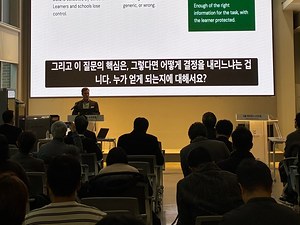
Day 1 Summit: Context for AI, Trust for Learning
Keynote: AI is only as helpful as the context it is given
Curtiss Barnes opened with a single question: “What should I study next?” Without context, AI gives everyone the same list of popular courses. With trusted context, it can suggest a next step that fits the learner's goals and progress. So the real question, he stressed, is who decides how much AI should know about a learner. Edtech companies can collect data in practice, but if no one sets the rules for that core question, AI is simply left to guess, and that should not be allowed to stand. 1EdTech's principle is that educational institutions should decide: provide just enough context for the task, while protecting learners' data sovereignty and privacy.
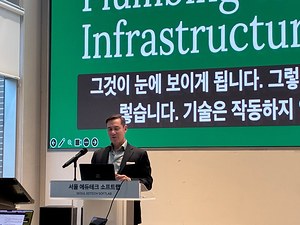
He presented standards, certification and app vetting (TrustEd Apps and TAMS) as a single layer of trust. In Pennsylvania, school districts share one 1EdTech membership, together with one way to vet apps and one set of privacy terms. More than 14,000 apps have already been vetted in TAMS. He also said 1EdTech plans to put new governance approaches, such as regional profiles and a lighter review process, to members for review so that standards can keep pace with AI.
He also introduced 1EdTech's new organizational structure. The member-led standards body, 1EdTech Consortium, and 1EdTech Global, a public-interest hub launched in 2026, share the same mission, and 1EdTech Korea is the network's official regional organization. He closed by inviting Korea to move up a level, from simply adopting standards to helping build them.
Fresh from Milwaukee: security, AI and learning context, and apps you can trust
Tim Couper gave Korea its first report from the 1EdTech Technical Congress held in Milwaukee in October.
- Security: AI has lowered the barrier for attackers, and the damage keeps growing, as this year's major learning management system breach showed. Standards cannot stop every attack, but they can limit how far one spreads. The key messages: stop using older versions built on shared secrets and use only current versions, and move to OAuth 2.1 and sender-bound tokens. When AI assistants act on behalf of teachers, he stressed, systems must authorize each individual action, not just the connection between systems.
- AI and learning context: 1EdTech has proposed six principles for Trusted Portable Learning Context (TPLC): consent, institutional data sovereignty, provenance, real-time context, querying only what is needed, and composing context from multiple systems. When an institution compiles context once and shares it across AI agents, it also cuts the cost of every agent rebuilding that context from scratch. The principles are open for public comment and will be tested in real systems in 2027.
- Apps you can trust: TrustEd Apps lists about 14,000 applications whose certifications are checked every year. In 2027 it will grow into a global product directory that reflects regional requirements, and building a Korean product directory together with 1EdTech Korea is an objective for 2027.
Digital badges: who manages them, and by what rules?
Professor Hong-Rae Kim of Chuncheon National University of Education and Hun Jung, CEO of Learning Spark, looked at the governance and operating models needed to run digital badges across society and in universities, drawing on successful cases from abroad.
Professor Kim compared the UK Digital Badging Commission, Australia's National Microcredentials Framework, Florida Gulf Coast University and Alamo Colleges in the United States, and University College Cork in Ireland. His conclusion: trust in a badge is shifting from “who issued it” to “what evidence proves it.” For Korea, he offered practical recommendations, including breaking the National Competency Standards (NCS) into smaller units linked to badge criteria, requiring evidence at each level, and a Trust Hub that verifies both issuers and badges.
Hun Jung followed with international trends in how digital badge ecosystems actually operate, and what they mean for Korea. If educational institutions and the private sector issue badges with real value, and national and public bodies verify those badges and raise the level of trust in them, he argued, employers will be able to move to competency-based hiring.
Following the two talks, Chair Yong-Sang Cho showed visually how competency frameworks, digital badges and the Comprehensive Learner Record (CLR) can be connected as one flow of data, and how such a digital credential ecosystem can ultimately support personalized competency development and career support for students. He shared part of a project now under way at a Korean university, and attendees told us it was a real eye-opener. 2027 looks set to bring major change to digital credential ecosystems, built on three edtech standards: CASE, Open Badges and CLR.
First public showing in Korea: a live demo of 1EdTech Korea Co-Labs
Chair Cho then gave the first demonstration of 1EdTech Korea Co-Labs, a set of tools that help systems and AI properly understand and use curriculum, competency and skills information. Public release is expected in late November or early December.
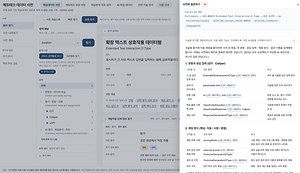
- EdTech Data Dictionary: A tool for searching the vocabulary and properties of ten major 1EdTech standards, including LTI, OneRoster, QTI, Caliper, CASE and Open Badges, along with other international edtech standards such as xAPI, and for designing data with the help of AI. Ask a question through “Ask the Dictionary” and the AI puts together an answer from what it can confirm in the dictionary and in 1EdTech's standards documents. Attendees were quietly impressed by a demo of AI-assisted learning analytics metric design.
- CASE Repository: An open dataset that expresses Korea's 2022 revised national curriculum and national competency frameworks such as the NCS and SQF in the international CASE format. Rather than documents written only for human readers, it will offer data free of charge that people and machines can each read in the form that suits them, and it is the first Korean repository to join the CASE Global Network that 1EdTech launched in June. What made it stand out is a built-in multi-agent AI pipeline: give it curriculum documents or competency framework data (from data.go.kr), and it extracts and structures the data automatically. Compared with extracting and organizing everything by hand, this can cut the time dramatically.
Day 2 Seminar: applying standards to products and getting certified
What standards give companies and universities
Curtiss Barnes explained the benefits of standards for companies and for universities. Companies can replace a one-off integration for every customer with a single standard, point to certification as the proof buyers ask for, and reach overseas markets with the same standards used by institutions in 36 countries. For example, connecting 6 tools to 5 campus systems takes 30 custom integrations, but with standards, 11 connections are enough, because each product implements the standard once. Universities get new tools that plug straight into their learning management system with grades returned automatically, learning data collected in one consistent format, and shared rubrics for choosing AI tools.
Which standard solves which problem?
Tim Couper walked through the core standards, problem by problem.
- LTI 1.3 and LTI Advantage: Launch tools securely from a learning management system, pass along course context, and return grades.
- OneRoster and Edu-API: Exchange classes, rosters and grades between student information systems and learning management systems. OneRoster serves K-12, and Edu-API serves higher education.
- CASE: Structure curricula, competencies and learning outcomes with shared identifiers, so that machines can understand competency and skills information, with all its different meanings, in a standard format.
- QTI and Common Cartridge: Exchange items, tests and packaged learning content between systems.
- Caliper: Capture learning activity data in one consistent format for analytics.
- Open Badges 3.0 and CLR: Portable digital recognition that learners carry with them.
These standards work together on a shared security foundation. He illustrated this with a single university assessment whose data flows from the student information system through the learning management system and analytics, all the way to employers.
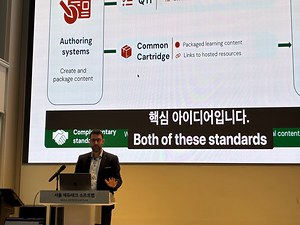
Standards AI can read: from zero to working in minutes
1EdTech is bringing its standards documents together on a new site (standards.1edtech.org) and providing a skill document (skills.md) with each standard to help AI coding tools understand and implement it correctly. The goal is “zero to working within minutes.” Tim Couper demonstrated building a OneRoster web service in moments using a skill document.
On the developer portal, the Build Portal (build.1edtech.org), developers can run conformance tests while they build, then go through a pre-check before applying for certification. The session also walked through the whole path from preparation to the certification mark in a way non-specialists can follow. 1EdTech Korea plans to support this process with Korean-language guides, pre-review consulting and the TACL course.
Same word, different context
Chair Cho also showed a lesser-known feature of the soon-to-launch EdTech Data Dictionary: when the same term is used in different contexts, the dictionary tells them apart and explains each one in its own context. It is the same idea as TPLC, the theme of the event: AI produces accurate results only when it is given accurate context.
Closing thoughts
One message ran through both days. In the AI era, standards are becoming more than the plumbing that connects systems; they are the foundation for giving AI accurate, trustworthy context. 1EdTech Korea will keep rolling out Co-Labs, connect Korea's curricula and competency frameworks to international standards, and actively help Korean companies and universities adopt standards and get certified.
Attendees who checked in on site have received a separate notice about the presentation materials. Thank you again to all the speakers and attendees who joined us.