
2026 Digital Credentials Summit — the era of experimentation is over
Three days in Philadelphia marked the shift in digital credentials from building to activation. With 320 million issued worldwide, digital credentials are past the experimental stage. The question that remains is not how to issue a badge, but whether that badge can be discovered, verified and carried from one system to the next.

From February 18 to 20, 2026, 1EdTech held its annual Digital Credentials Summit in Philadelphia. It is the largest gathering in the field, bringing together universities, employers, edtech companies and policymakers around digital credentials.
Reduced to a single sentence, three days of discussion come to this: the era of experimentation is over. The groundwork of the past decade — building standards, frameworks and good practice — is largely complete, and the task has moved from building an ecosystem to making it work at scale.
With the conversation about digital badges gathering momentum in Korea, it is worth looking at what has been learned in places that are already a few steps further down that road.
1. The numbers mark a turning point
Figures from the Counting Credentials 2025 report, cited at the summit, compress the situation.
- More than 1.7 million unique badges worldwide
- More than 320 million issued in total
- More than 97,000 issuing organizations
At this scale the question is no longer whether it is worth trying. The focus naturally moves to the next set of questions: are these 320 million records connected to one another, can employers read them, and can learners carry them with them?
From black box to glass house
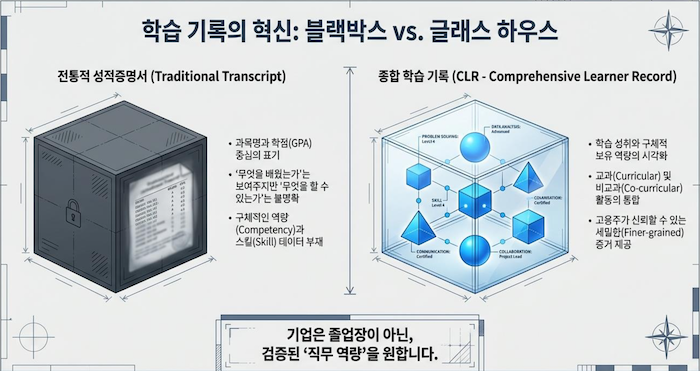
The contrast that best captured the summit's concern was the comparison between the academic transcript and the comprehensive learner record.
A traditional transcript is organized around course titles and credits. It shows what was studied but not what the holder can do, because it contains no specific competency or skill data at all. A Comprehensive Learner Record (CLR), by contrast, surfaces learning achievement together with the competencies actually held, brings curricular and co-curricular activity into a single record, and gives employers granular evidence they can trust.
The starting point was that employers want verified job competencies rather than a diploma, and that the transcript as it stands cannot answer that need.
Five core judgments
Five judgments were reaffirmed repeatedly over the three days.
- CASE redefined — elevated from a simple exchange format to shared global infrastructure
- Wallets and CLR evolve — from copies of a transcript into career portfolios the learner controls
- Institutional capacity at the center — governance, integration with academic operations and employer connections, more than technology itself, determine success
- The AI and verification dilemma — the more content AI generates, the more human verification matters, paradoxically
- The shift to integrated platforms — what is needed is not issuance alone but a comprehensive solution combining structured competency management with AI skill extraction
The sections below take these five in turn.
2. CASE redefined — from exchange format to public infrastructure
Where the breaks have been
The chain breaks in two places. One is between levels of schooling: competency data a student accumulates in K-12 does not carry over into higher education. The other is between education and the labor market: a university transcript lists course titles such as algebra or principles of management, and is never translated into the units of skill employers ask for.
The new role assigned to CASE is to bridge these breaks — to provide a semantic foundation that interlinks degrees, courses and skills in machine-readable form, and so to become public infrastructure that secures workforce mobility across countries and industries, rather than one institution's proprietary format.
Same competency, different names
A concrete example helps. For the single competency of critical thinking, several US organizations maintain frameworks of their own. A higher education association's learning outcomes rubrics, an education innovation organization's 21st-century skills, a hiring association's career readiness framework and a consulting firm's foundational skills taxonomy all use different names and different definitions.
CASE makes it possible to declare equivalence among them. A university's curriculum, a learner's digital wallet and an employer's job requirements then sit on the same coordinate system. It is a way of making frameworks interoperate without asking anyone to give up their own.
Authority stays local; connection runs on public infrastructure
One principle stated here was particularly striking: "Authority remains local, coordination is shared." Control stays with each institution; only the connections are coordinated through public infrastructure.
It works in four steps.
- Register — an issuing organization shares the metadata of its framework with a global registry
- Discover — users query the index to search frameworks from around the world
- Subscribe — users are notified automatically when a version changes or content is revised
- Retrieve — the framework itself is fetched directly from the originating organization's server, not from a central server
The key is that nothing is gathered into a central database. The registry holds only what is where; authority over the content remains with the originating institution throughout.
3. Four standards, one division of labor — the song, the playlist and the catalog
A common misconception is that the digital credential standards compete with one another. An analogy offered at the summit clears this up.
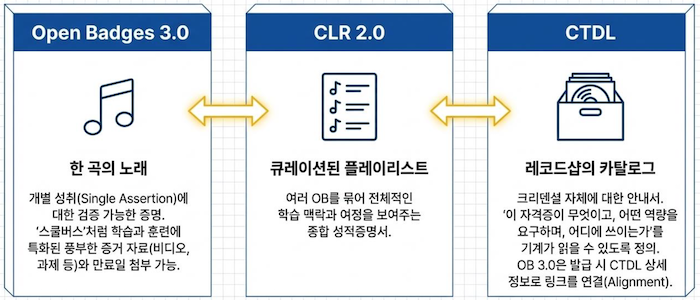
- Open Badges 3.0 is a single song: a verifiable proof of one individual achievement. It can carry rich evidence such as video or assignments, and it can include an expiration date
- CLR 2.0 is a curated playlist: a comprehensive record that bundles multiple badges to show the overall context and journey of learning
- CTDL is the record shop's catalog: a guide to the credential itself, defining in machine-readable form what a credential is, which competencies it requires and where it is used. Open Badges 3.0 links to the detailed CTDL information at issuance
One more piece completes the picture: Wallet Attached Storage (WAS). It addresses a critical limitation — lose your smartphone and your digital credentials disappear with it — by connecting verifiable credentials, under encryption keys, to cloud storage the user chooses, ensuring lasting access. It removes the assumption that a wallet is bound to a device.
A badge, seen as technical structure
Open Badges 3.0 is not a simple image file but a data object conforming to the W3C Verifiable Credentials (VC) specification. It has three layers: a visual layer that people see; a data layer carrying the issuer identifier (DID), CASE-based skill alignment and evidence; and a security layer carrying the cryptographic proof. A single badge contains who issued it, which competencies it connects to and what it rests on — and all of it can be verified.
Reaching the hiring system
The last stretch between education and hiring is covered by the Trusted Career Profile (TCP), a profile standard that converts Open Badges 3.0 and CLR issued by universities into a form an employer's applicant tracking system (ATS) can parse and trust directly.
This is where it matters. However good a learning record is, if the employer's hiring system cannot read it, nothing comes back to the learner. The change this standard aims at is for data signed by the issuing institution — not a résumé the applicant fills in — to enter the hiring system intact.
4. What three universities showed — governance over technology
Implementation cases from three US universities were presented side by side. Their approaches differed, and so did the lessons.
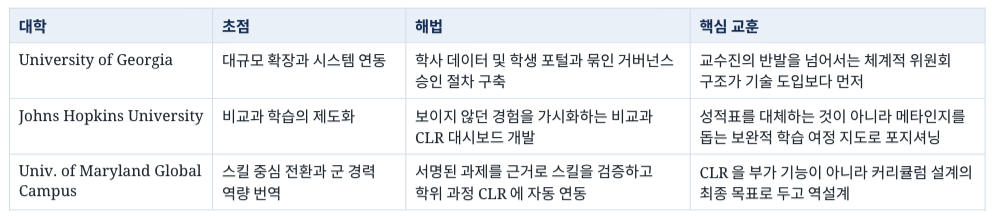
One lesson ran through all three: the hard part is not the system but people and authority.
It was especially clear in the University of Georgia case. The whole process — defining an institution-wide competency framework, mapping curricular and co-curricular activities to it, and making them searchable and selectable in the student portal — was a matter of agreement more than technology. Johns Hopkins University distinguished achievements assessed by faculty from achievements students post themselves, and designed the latter so that students can request verification. It also set aside a narrative space where students frame their own story to fit what employers are looking for.
Redefining the T-shaped learner
A model cited often at the summit was the T-shaped learner. The vertical bar is deep expertise in a discipline, where universities have traditionally been strong; the horizontal bar is transferable competencies — communication, leadership, problem solving — that industry demands and validates.
The proposal that followed was a challenging one. To respond as the traditional signal of a degree weakens, universities should first define the attributes of their graduates and reverse-engineer degree programs from there — inverting the usual order of building a curriculum and then describing its outcomes.
A wallet used by 580,000 people
As a case of operation at scale, the summit heard about Western Governors University's Achievement Wallet. More than 588,000 students, alumni and staff use it, and the university has fully converted PDF transcripts into skills-based credentials and CLR. Experience outside formal coursework, such as military service or volunteering, is captured in a visual profile as well.
The standout feature is skill gap analysis. It maps a learner's current skill set against the job requirements of the actual hiring market, identifies missing competencies and immediately recommends learning pathways to fill them. It is a case of a wallet that stores records turning into a tool for designing a career.
5. The AI paradox — the more automation, the more human verification matters
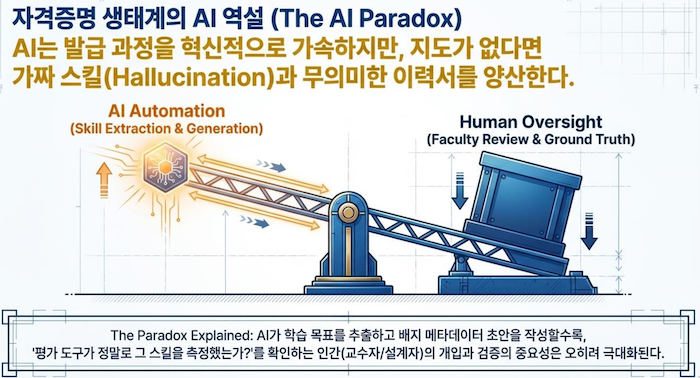
This was the theme stressed most often at the summit. In short: AI dramatically accelerates issuance, but without a reference point it mass-produces fake skills and meaningless résumés.
The structure of the paradox is simple. The easier it becomes for AI to extract learning objectives from a syllabus and draft badge metadata, the more important human intervention becomes to confirm whether that assessment actually measured that skill. More automation does not lower the value of verification; it raises it.
Designed to work only on a reference base
One answer presented was a metadata generation tool being developed by the Digital Credentials Consortium (DCC). It uses a small language model to extract skills from syllabus text and produce a draft Open Badges 3.0 badge template — criteria, description, skill tags and image.
The design principle is the point. It does not create something from nothing. It is constrained to operate only on validated reference data: CASE competency frameworks and the CTDL metadata catalog. Rather than letting the model invent plausible-sounding competency names, it is made to choose from within a competency structure that has already been approved.
Similar approaches appeared in several places. Small language models that automatically generate badge metadata from syllabi and course data are under joint development by several universities, and commercial solutions that align university curricula with labor-market skill demands in real time have also emerged. What they share is that they use AI as an aligner, not a generator.
6. The hardest problem is not the technical spec
That was also the title of the summit's most candid session. Writing a system specification is easy; realigning authority among campus units and building faculty consensus is a painful, lengthy process.
Four parties are involved: faculty, IT, academic affairs and employers. Each holds different authority and different interests, and the system does not run if any one of them is missing.
Four questions governance must answer
Four things were put forward as decisions to settle before implementation — ahead of any technology choice.
- Source of authority — who approves the definition of a given skill or competency: a departmental committee or the central academic office?
- Evaluation of evidence — which forms of evidence (projects, video, quizzes) are valid, and who carries out the assessment?
- Control of issuance — is the final trigger for issuing a badge system automation or an instructor's manual signature?
- Editing rights — how far can students add context to an issued record, and where must the line be drawn so that verified data is not compromised?
Start where you are
The strategic recommendation was clear. Do not try to build a perfect, complete system in one go. Start with a workable federation built on what the university already has — its curriculum data, student information system, learning management system and academic structures.
The three universities described above all followed this path. None began with full rollout; each began with one department, one program or one kind of achievement.
7. What this means for Korean universities
From issuing engine to skills ecosystem
The first thing to address is the goal itself. Korean universities have generally approached digital credentials by adopting a platform that issues micro-degrees or badge images, and many have stopped there.
In light of the summit's discussion, that goal needs to change. The core is not issuance but discoverability and interoperability. A badge only becomes valuable to the learner when it can be found in other systems, its meaning can be interpreted, and it can travel all the way to a hiring system. The number of badges issued is not an outcome in itself.
Connecting NCS to an international vocabulary
One concrete task that follows is mapping Korean competency frameworks such as the National Competency Standards (NCS) to CTDL-ASN. [+] NCS is Korea's national framework defining, by industry and job, the knowledge, skills and attitudes required to perform work. This opens a direct route connecting a national framework to global labor markets and corporate hiring systems.
The principle discussed above — authority stays local, connection runs on public infrastructure — applies directly. This is not about changing or abandoning NCS, but about declaring what NCS means in a form outside systems can read.
Four interlocking gears
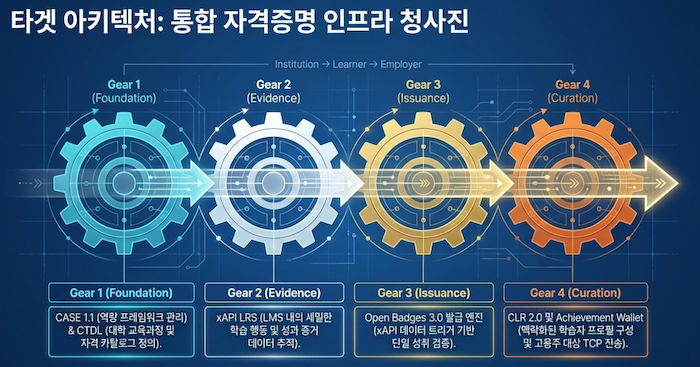
Synthesizing the summit's content, the target architecture interlocks in four stages.
- Foundation — manage competency frameworks with CASE 1.1 and define curricula and credential catalogs with CTDL
- Evidence — use an xAPI-based learning record store (LRS) to track granular learning behavior and performance data from within the learning management system
- Issuance — an Open Badges 3.0 issuing engine verifies individual achievements, triggered by learning record data
- Curation — CLR 2.0 and the achievement wallet assemble a contextualized learner profile and deliver it to employers via TCP
The flow runs from institution to learner and on to employer. Skip any stage and there is no data to feed into the next.
A three-year phased path
A realistic adoption sequence is set out here as well.
- Phase 1, first 6–12 months — systematize the institution's skills taxonomy and adopt a CASE framework. Convert existing major credentials and curricula into CTDL metadata, and form an issuance governance committee
- Phase 2, years 1–2 — connect the learning management system to a learning record store to build a pipeline that collects learning evidence automatically, and begin pilot Open Badges 3.0 issuance for a specific major or capstone course
- Phase 3, years 2–3 — package all achievements as CLR 2.0, roll out learner wallets to the whole student body, activate AI-based career mapping and integrate with major hiring platforms
It is worth noting that the governance committee sits in Phase 1. The earlier lesson — sort out authority before adopting technology — is written directly into the roadmap.
In closing — a blueprint for the next decade
The summit's closing message was that the groundwork of the past ten years is done, and that the goal now goes beyond building an ecosystem to activating it at global scale, creating real opportunity and impact. It is a blueprint for the next ten years, pointing toward a state in which learners reclaim their rights to their own learning data, employers discover hidden talent, and universities are synchronized with the labor market.
Korea is still at the groundwork stage. That need not be read only as falling behind. What the early movers struggled with is already documented, and much of it has proven to be a matter of governance rather than technology. There is no need to struggle through it in the same order.
For reference, from 2027 the Digital Credentials Summit will be combined with 1EdTech's Learning Impact Conference, bringing K-12, higher education and the labor market into a single forum. It reads as a sign that credentials are no longer a separate topic but a question for the learning ecosystem as a whole.
See also
- Digital Credentials Summit 2026 — official 1EdTech event page → https://www.1edtech.org/event/dc/summit/2026
- Digital Credentials — 1EdTech digital credentials workstream → https://www.1edtech.org/workstream/credentials
This article is 1EdTech Korea's account of the 1EdTech Digital Credentials Summit 2026 (February 18–20, 2026, Philadelphia). It may include the personal views of individual presenters; for the official content of any standard, please refer to 1EdTech's published documents. The statistics cited are figures from the Counting Credentials 2025 report as presented in summit materials.