
1EdTech London Summit 2026 — half a day in London, and two words that kept coming back: MCP and trust
At the 1EdTech summit held in London in January 2026, Google, Microsoft, the French government and edtech companies all talked about MCP. The question that lingered, though, was not how to open the door but what to show once it is open.

On January 20, 2026, the 1EdTech London Summit was held at Central Hall Westminster in London. Microsoft provided the venue, and representatives from Google, universities, government, research institutes and edtech companies came together. It ran only half an afternoon, but listening to the presentations in sequence made one thing clear: people standing in very different places were holding on to the same problem.
Two words came up again and again. MCP, and trust.
1. Everyone talked about MCP, and everyone had a different reason
MCP (Model Context Protocol) is a common protocol that lets large language models discover external services, communicate with them and act through them. Four presentations that day referred to MCP, and each spoke from a different position.
For an integrator, it was a tool for opening silos. One edtech integration provider showed a case in which it analyzed course content and data drawn from a university's learning management system and campus systems, built a semantic index from them, and exposed that index over MCP. The demonstration was simple. A student asked what to study in 30 minutes over the coming week; the agent identified the current week's topic for that course, located materials such as slides and worksheets, and produced a concrete study plan. The presenter put it precisely: the silos had not been removed, but they had been opened.
For government, it was a technical standard for national information systems. France's presentation on its digital education strategy was the most operational of the day. The plan is to build the search engine for its training platform as an MCP server, so that any language model can connect to it and search training courses, and to designate MCP servers as the technical standard linking government information systems to training platforms. The presentation also set out plans for an AI framework for education developed with more than 500 experts, and for sharing the outputs of innovation partnerships with the whole population as a digital commons.
For a platform company, it was a common language for the ecosystem. A figure from the presentation by Google's education team stood out: students and teachers use more than 40 tools in a month. The strategy that follows, the presenter said, is not to bring users to your own product but to be present wherever the users already are. The demonstration wove Gemini and Google Classroom together over MCP with third-party platforms such as Moodle, with YouTube, and with tools that are not Google products at all. The presenter's own framing captured the mood of the day: what matters is not whether something is a Google product but whether it helps education.
The point worth noting is that nobody that day proposed consolidating onto a single platform of their own — and that included the large platform companies.
2. Once the door is open, what do you show?
If MCP is the technology that opens the door, the next question follows naturally. That was the question 1EdTech put on the table.
The session opened with an experiment run on the audience. Given six questions posed by a student, participants were asked to choose whether the language model should decline to help, give a generic answer, or answer as fully as it can. The conclusion was framed this way: when AI fails to help a learner, it is usually not a failure of the model but a failure of information. The system cannot see what the student already knows, and the goals it recommends are not connected to the standards the school works to.
This is where the concept of learner state was introduced: information about what a learner is doing right now, why, and within which framework. The difficulty is that this information is scattered across student information systems, learning management systems, entitlement and access systems, curriculum and competency frameworks, and individual accommodation records such as extended time or visual supports. What we hold today is not a whole picture but fragments.
The proposed remedy was a learner snapshot: rather than handing over an entire history, generate a snapshot holding only what a particular moment requires, with new states created continuously over time.
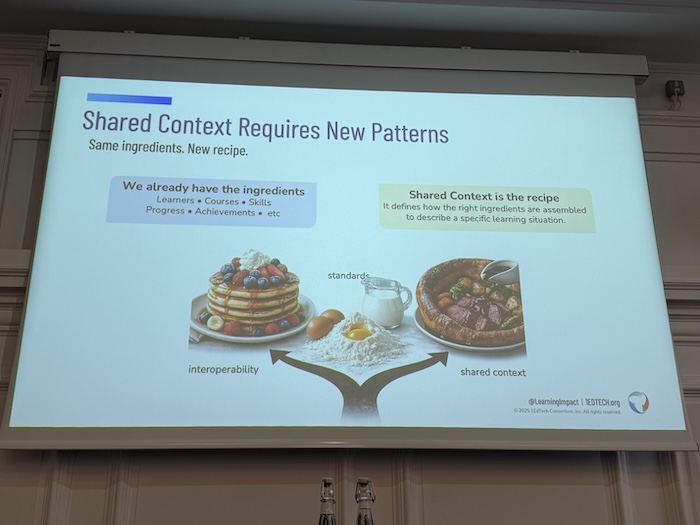
Then came the most memorable analogy of the day. Pancakes and pudding use almost the same ingredients; only the recipe differs. The point is that no new data model is needed. What is needed is a common structure for connecting information the community has already agreed on over 25 years, and that is a matter of agreement rather than technology.
3. Trust is a different layer of the same stack
The next presentation opened by comparing educational infrastructure to road infrastructure. Education sits on one side; work, industry and AI on the other. AI is trained globally but has to understand local conditions, and human capability has to be verifiable across borders.
The trust built over the past 25 years was system-to-system trust, with LTI as the representative case: system A knows system B, and they exchange data inside a relationship an administrator designed in advance. Over the last decade, though, new connection problems have arrived all at once — country to country, work to education, and AI to people. A centralized trust model does not work in that world.
The presentation named four standards to carry global trust.
- Open Badges — the trust model is built into the credential itself, and data provenance can be traced. The presentation reported more than 350 million issued and in use across multiple industries
- CLR — a portable record of learning, under development as part of the 1EdTech Europe Initiative
- CASE — a standard for describing competencies and skills in machine-readable form, in use in several regions including Korea and the United States, and expanding to CASE Global in 2026
- Decentralized Identifiers (DIDs) — the foundation for managing relationships between systems, letting a learner hold records from many sources while retaining control over them
What the four have in common is that they are open, transparent, machine-readable and verifiable. The closing line of the presentation was the gist of the session: trusting AI requires trust mechanisms, and the two are different layers of the same stack, equally important.
Policy people can read
The demonstration that followed made this abstraction concrete. The scenario had an AI requesting information from a badge held in a digital wallet.
Under the default policy, the AI receives the badge information in full. Who made the request, what the badge contains, what was released, and the digital signature are all displayed alongside it. The presenter then changes the policy to one stating that this requester does not need personal information. On the next request, the AI does not receive it. One more change, and nothing is returned at all.
The policy document sitting on the right of the screen was the crux of it. It was not code but sentences a person can read. Privacy policy, institutional policy, municipal policy and international policy can all be expressed the same way, and simple, deterministic software enforces them. The message of the demonstration was that data policy has become something people who are not developers can read and question.
4. The same problem, seen from the classroom
Placing practitioner sessions between the technical ones was a good arrangement.
A presentation from a US K-12 data platform explained the unified learner profile by analogy with a medical record: so that changing hospitals does not mean repeating the same tests and retelling the same story, behavioral, academic and engagement information is gathered in one place to form a profile that grows with the student. The reality check that came with it stung. If there are ten pages of information per student and a teacher is responsible for 150 of them, remembering it is impossible. The requirement that follows is that educators, not data specialists, must be able to work with it in everyday language.
A university in Dubai presented an incident. A flaw that allowed students to generate inappropriate images with AI was discovered and escalated to senior leadership, and the technical team resolved it within six hours by changing access controls. The lesson the presenter drew: technology succeeds when people succeed. The presentation went on to sketch a shift — where the educator in traditional schooling was a transmitter of information, in the age of AI the educator becomes a mentor and coach, and content design moves into collaboration with AI. The point is not to tell students not to use AI but to teach them to use it properly.
A presentation from a UK digital services body for higher education summarized what institutions are wrestling with. Assessment tools are improving and strong new entrants are appearing, but individual tools and point solutions do not solve the problem on their own. The conclusion was that if an institution is to keep its pedagogical choices while also securing operational efficiency, data standards have to bridge the two.
5. What this means for Korea
First, MCP can be treated as an instrument of policy rather than as a tool. France is designating MCP servers as the technical standard for national education information systems and opening training-course search to any language model. Korea likewise has a considerable body of education and training data already published through open APIs. Whether government sets a standard route for agents to reach that data, or leaves each service to work it out alone, is a decision that can be made now.
Second, the conversation about opening the door and the conversation about what to show have to proceed together. Korea's discussion of AI in education concentrates largely on models and services. If London's diagnosis is right, and AI usually fails to help a learner because of an information failure, then what is needed is not a better model but a data structure capable of assembling learner state. The ingredients already exist as standards.
Third, writing policy so that people can read it becomes a technical task. What the badge demonstration showed is that a privacy policy can be more than a configuration value only developers read: it can be text that schools, education authorities and parents read and revise together. This meets the current movement in Korea toward requiring schools to review security and personal data handling before adopting edtech.
Six months on: how far did London's question travel?
One thing became clear while putting this piece together. The problem raised in London in January as learner state and learner snapshot acquired a name at Learning Impact 2026 in June — Trusted Portable Learning Context (TPLC) — and took shape as six candidate properties. In the meantime, 1EdTech has opened a public review on it.
Six months from raising a problem to a draft standard. That standards move at this speed means the gap between taking the result late and taking part in the discussion is just as short. Had Korea's circumstances been on the table in the room where pancakes and pudding were discussed, the current draft might look a little different. Fortunately, the public review is still open.
This article is 1EdTech Korea's account of the 1EdTech London Summit held on January 20, 2026. It may include the personal views of individual presenters; for the official content of any standard, please refer to 1EdTech's published documents.